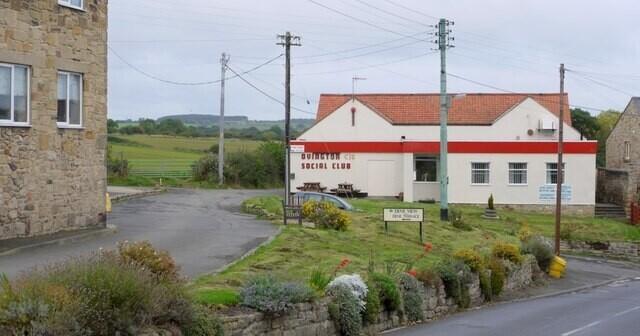
Based in a tiny Northumberland village, Ovington Social Club is effecting a fine balance between innovation and tradition in order to ensure the club continues to flourish
Despite being situated in one of the smallest parishes in the entire UK, Ovington Social Club in Northumberland has been serving its members for just over a century – having opened for the first time in July 1921 – and continues to plan for a bright future.
With only 500 inhabitants living in the rural village surrounded by farmland and open countryside, the club has an impressive total of 201 members, a significant proportion of whom use the club multiple times per week.
However, with club-going habits changing, they are increasingly dependent on a mix on regular and one-off events throughout the year to sustain the profile of the club amongst the local community.
Having negotiated its way safely through the Covid lockdown period, which saw a number of refurbishments carried out on the building’s interior, the club has successfully relaunched but still faces many challenges under a new regime which was installed at the club’s most recent AGM held in April of this year.
New Chairman Gary Bosworth, who served on the Committee for two years before taking over his current role, pays tribute to the long line of previous custodians of the club who have kept this precious local asset going for the past 100 years.
“I’m a relative newcomer to this club, having only moved into the village in 2020,” he says.
“But it’s clear that the previous Officers and Committee Members put in so much hard work over the years for the good of the club, notably John Little, who served as Secretary for two decades before stepping down,” says Gary.
“We still have one Committee Member in his 90s, Geordie Henderson, who has been a member since he was 18.
“Our Steward, Terry Liddle, is in his 25th year in the post too, and that continuity is essential to allow the changes that we are keen to try.
“As of April, the club has a new Secretary (Lynn Burnip), Treasurer (Lorraine Burns) and Chairman so we’ve really had to just come in and learn as we’re going along.
“Almost immediately you are in a situation where you have to make very significant decisions. “For example, as a small club, we have been trading just under the VAT threshold for the past five years.
“Now, prices have gone up but the VAT threshold has remained the same so we’ve now hit that threshold.
“So that is going to impact us. We had to make the decision on whether to close two or three nights a week in order to stay under the threshold – which was our accountant’s advice – or to accept that to be sustainable, to keep employing our Steward and our one regular member of staff, we really need to grow the business.
“That means you can’t just grow a little bit, but you've got to grow enough to make the money you need, plus the additional implications of that.
“So we took the decision to have a go and see if we can grow it enough that we can sustain being a VAT registered club.
“But it’s a challenge given the size and nature of the club. We’re not here to make profits as such. We’re here to make enough to be sustainable. And yet we’re getting hit by the Government in this area.”
Gary is certainly as well informed as could be about the environment in which the club operates, given his day job as Professor of Entrepreneurship at Northumbria University’s Newcastle Business School where he specialises in research on rural economies.
He cites boosting the number of members as one of the club’s priorities.
“We certainly haven’t been recruiting new members very much in the last few years which I think tells the story of how rural communities are changing,” he says.
“People that move into the village are often commuting to Newcastle, Hexham or other bigger towns and are perhaps not traditional clubgoers.
“We do have some competition in the village with a pub stroke Mediterranean restaurant just over the road which is open five nights a week.
“We actually took the decision to shut on Wednesdays but otherwise we’re open six nights a week and all day Saturdays and Sundays.
“This summer we’ve increased our hours at weekends in a bid to attract the many people who come up to this area to walk their dogs around the Whittle Dene nature reserve which is close to the club.
“We put doggy treats out, as well as picnic tables and umbrellas and make sure the doors are wide open so walkers are encouraged to come inside and have a drink.
“We are also planning an Open Day to showcase the club to potential members and to break down any uncertainty about what membership entails and what it costs.
“Getting people in through the doors for the first time is important as you can’t see into the club from the outside and the entrance is tucked around the side.
“So, for the Open Day we will be throwing open the big fire doors at the front to make it more welcoming and showing people the benefits of being a member and all for a relatively small amount of money per year.
“You have to look at it from the point of view of people who don’t know about clubs and probably have negative perceptions which need to be broken down – like, for example, whether non-members are allowed in.
“It’s our job to communicate better. We have a big sign up saying ‘Guests Welcome’ but we still get asked whether non-members are allowed in!
“So now we are reinforcing messages through our Facebook page, a quarterly newsletter and just encouraging people to spread the word locally.”
The club’s Committee is also keen to strengthen the bonds between village residents and the club.
“We have a large Function Room that is an ideal space for village events but finding the best ways to collaborate within the village hasn’t always been straightforward,” explains Gary.
“We are also mindful of not competing against other village events. As nn example, there was a party held on the Village Green for the recent Coronation so we were not going to host a ‘rival’ event at the club.
“But when the Autumn Fayre is on, we always combine it with the annual Leek Show in the club.
“At the same time, we want to get the balance right between the longstanding members of the club who have family associations going back decades and the need to encourage new members.
“We’re looking at a gradual evolution rather than making a load of radical changes which could alienate existing members. We don’t want to turn our back on a century of tradition.”
But there have been innovations alongside traditional club activities with the club staging the inaugural Ovington Beer Festival in 2022 and repeating the event earlier this year.
“Both of our beer festivals have been profitable for the club and also raised money for charity,” says Gary.
“But the main benefit of establishing an annual beer festival is that the club brought new people in and got people talking about the club in a different way.
“We had a variety of beers from local brewers – including the Allendale Brewery who supply us with Cask Ale throughout the year – and also invited along a young couple from the local area who has just started up a hot dog van business and they went down a storm.
“We also raised money to send a group of teenagers to the World Irish Dancing Championships in Canada and visitors to the Beer Festival were able to see one of the best Irish dancers in the world perform at our club.
“The support we received from local business was also very pleasing with 10 different local companies each sponsoring a beer to help us reduce our liabilities. For the 2023 Beer Festival, we were actually sponsored by the Northumberland Show, which is a huge agricultural show which takes place in the county.
“They were delighted to be supporting the club and also helped to promote our event.“
"So, you can see that from an event like the Beer Festival, the club suddenly starts making connections all over the place and is being talked about in a very positive way.
“We're currently organising an Oktoberfest event for later in the year as a one-day event with German food and a couple of German-style lagers from a local brewer next to Hadrian’s Wall.
“It’ll be something new and hopefully people will come along simply because they've not been to an Oktoberfest in Ovington ever before.“
Another thing we’re trying out is a ‘Co-working Day’.
“We have a good WiFi network at the club so will be putting out the word inviting people working from home to come down and work at the club from 9.30am until midday and then get a pizza over in the pub afterwards.
“It’s the sort of thing which could work, generate a positive message about the club and create new connections and members for the club.
“But, of course, alongside special events, it’s the day-to-day routine of the club which is the most important thing; providing a place for our members – many of whom would be fairly isolated otherwise – to socialise and have a game of darts, pool or dominoes with friends and family.“
The connection with the village is very important and the club is where the whole village assembles for Remembrance Day as there is no church in the village.
“It’s always a poignant occasion and demonstrates how integral the club is to village life and how the history of the village and club are intertwined.“
"That’s an important point as we continue to plan for the future in a changing environment.”